
Music Therapy and Emotional Well-Being: Expression, Identity and Relationships.
How a professional process can create space to explore emotions, identity, personal resources and ways of relating through music.
Content updated: · Translation completed:
Key points for this article
An illustrative example
Imagine someone choosing a song to discuss a change in their life. Listening feels uncomfortable, and they ask to stop. The professional respects that choice and discusses another way to participate. This is an illustration, not a patient case or a clinical result.
A goal differs from a result
Exploring expression, identity or relationships describes possible goals. It does not demonstrate that an activity treats depression or anxiety. Consent, the option to stop and ongoing review remain essential.
Space to explore, rather than an automatic solution
CMM includes emotional and psychological well-being among its areas of support. Music therapy may offer space to explore emotions, identity, personal resources and relationships through supported musical processes. This possibility does not mean that a song has the same effect on everyone or that listening to music alone constitutes treatment.
The experience develops within a professional relationship. Its direction depends on an assessment, agreed goals and what the person communicates throughout the process.
Starting with the current situation
Initial guidance gives people an opportunity to explain what they are seeking, for whom and in what context. Some arrive with an emotion that is hard to name; others wish to understand their relationship with music, their relationships with others or their personal resources. A complete explanation is not necessary to request information.
Before proposing sessions, the professional learns about relevant background, preferences, needs and current support. This conversation also clarifies boundaries and helps determine whether music therapy is appropriate or another form of care would be more suitable.
Human goals that can be reviewed
After assessment, clear and relevant goals are established. Depending on the person, they may involve expression, identity, participation, interaction or exploring resources. A technique is not chosen first and then assigned a purpose.
Goals are reviewed throughout the process. If priorities change, an experience stops being useful or a different need emerges, support should be adjusted. Flexibility does not remove direction; it helps preserve its purpose.
Expression beyond words alone
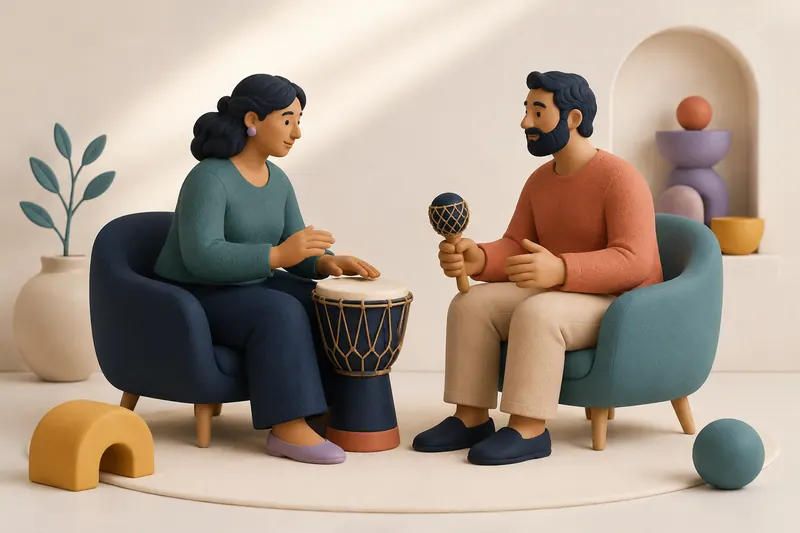
Improvising, singing, composing or adapting lyrics may offer ways to represent an experience. A choice of sound, a change in intensity or a pause may also communicate something. The professional listens and supports without assigning universal meanings.
The person retains the option to explain, correct or withhold what a piece of music represents. A minor key does not always equal sadness, and a fast rhythm does not mean the same thing to everyone. Meaning emerges from personal history, context and relationship.
Receptive listening and conversation
A session may include listening to music and discussing sensations, images, memories or ideas. Listening is not used as a recipe for producing a particular state. It is selected and adapted in relation to the goals.
It is also possible to stop a piece, change it or choose not to listen. Preferences and boundaries are part of the clinical information. Respecting them helps establish safe participation centered on the person.
Identity and musical history
The music that accompanies a life may be connected with stages of life, communities, values and ways of seeing oneself. Exploring that history can raise questions about identity without reducing a person to a musical genre or a favorite song.
The professional's chosen repertoire should never replace the participant's voice. Asking what they listen to, what they avoid and what place music holds in their life allows work to begin from meaningful references without imposing tastes.
Recognizing personal resources
Creating a rhythm, sustaining attentive listening, choosing between options, asking for a change or contributing a phrase are actions that may reveal resources. A session offers space to observe these and use them in experiences connected with the goals.
These resources are not graded as talent. There is no need to sing in tune or play an instrument. Participation is adapted through voice, body, instruments, movement, images or technology, according to the person's strengths and needs.
Relationship and interaction
Music may also organize turn-taking, responses and shared moments. During improvisation, the professional may support an initiative, offer contrast or leave space. Interaction is observed sensitively, without forcing closeness or interpreting every response as progress.
In family or group formats, goals and roles must be agreed. Each participant keeps their own preferences and boundaries within the shared experience.
Documenting the process without grading it
Follow-up records what happens in relation to the goals. It does not assess whether the music sounded “beautiful”. It observes participation, decisions, forms of expression, interaction and other elements relevant to that person.
Documentation supports discussion about direction, recognition of changes and adjustments to activities. It also helps identify when support should end or be integrated with another specialty.
Interdisciplinary work and boundaries
Music therapy may form part of interdisciplinary work. In that setting, each professional retains clear responsibilities and shares only the information needed to coordinate goals. Music provides a medium for experience and relationship; it does not replace the tools of other disciplines.
CMM's website explicitly states that music therapy does not replace diagnosis, medical treatment, psychotherapy or emergency care. If a need arises that requires those services, appropriate referral is necessary.
Questions for an initial conversation
It can help to share expectations of the process, what support is available and the person's relationship with music so far. It is also useful to ask how assessment will take place, how goals will be agreed and how they will be reviewed.
Emotional and psychological well-being does not come from a universal playlist. A responsible process listens to the person, adapts experiences and recognizes its limits. Music may create space for expression, identity, resources and relationships when there is a clear professional purpose and a relationship that is continually reviewed.
CMM sources
Read the institutional pages that provide context for this article:
How this article was prepared
Institutional information about the professional process and its possible goals. Professional references were consulted on September 5, 2026; they provide context and do not establish specific clinical benefits or certify CMM credentials. This is not a systematic review or a documented human clinical review. The translation preserves the original scope.
Sources and scope of access
- AMTA: professional definition
Complete institutional definition. Specific training, credentials and the therapeutic relationship are described in their US context; this does not establish automatic legal equivalence in Mexico.
- WFMT (2011): international definition
Complete institutional definition, including cultural, social and political contexts. It does not establish CMM membership or the effectiveness of a particular service.
- NCCIH: music and health
Public institutional text: relevant sections on professional practice, differences between interventions and precautions. Its dementia summary does not replace the later studies cited.